Bakery Social Media Marketing That Makes Freshness Feel Irresistible
A practical, bakery-specific guide to turning oven timing, display-case rhythm, menu drops, and occasion planning into social posts that make customers hungry enough to act.
A bakery does not sell only baked goods online. It sells timing, texture, smell, comfort, and the tiny panic of seeing the last almond croissant in the case. This guide shows bakery owners how to turn those real shop moments into practical social content without sounding like every other cafe account.
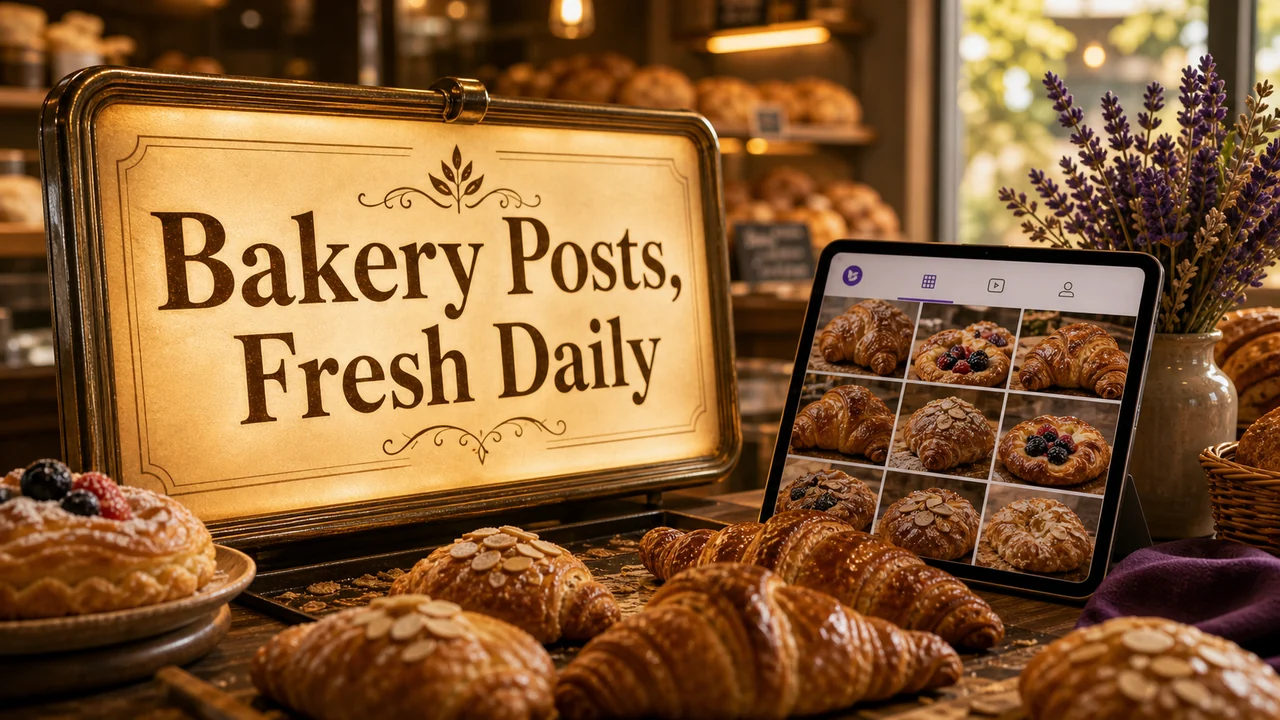
At 7:42 in the morning, the best bakery content is usually not on a planning board. It is cooling on a rack, cracking under a knife, getting boxed for pickup, or disappearing from the display case faster than expected. If your social feed is missing those moments, customers only see a menu. They do not feel the morning rush, the butter in the lamination, the crumb on the sourdough, or the little decision that makes someone pull over for coffee and a pastry.
That is why bakery social media has to work differently from generic small-business content. A dentist can build trust by reducing anxiety. An accountant can build trust by making deadlines feel manageable. A bakery builds trust by making freshness believable. People want to know what is available today, what will sell out, what they should preorder, and whether the cake, cookie box, or catering tray will look as good in person as it does in the post.
Bakery marketing works best when content connects product, timing, and local habit. The practical move is not to post more. It is to post closer to the way bakery customers actually decide: what is fresh, what is available, what needs preorder time, and what is worth leaving the house for today.
Film the first tray leaving the oven; compare proofed dough with finished rolls; show cake boxing before pickup; post the display case at 9:00 and 12:00; explain holiday preorder cutoffs; share a staff pastry pick; turn a storage question into a saveable carousel; show an office catering tray being assembled.
Start With The Smell Test
Before writing any caption, ask whether the post would make someone imagine the product in their hand. If the answer is no, you probably have a product record, not a bakery post. A close-up of a croissant can work, but a close-up of the torn croissant showing honeycomb layers works harder. A cake photo can work, but a cake being lifted into a box with the customer's pickup tag visible gives the viewer a more specific promise.
Use bakery language that has sensory weight: laminated, proofed, glazed, seeded, filled, crusty, tender crumb, pull-apart, still warm, fresh from the oven, boxed for pickup, sliced for catering, last tray, preorder cutoff. These words are not decorative. They are buying cues.
A simple weekly rule helps: every product post should include one of three proof points. Show time, such as 'out of the oven at 8:15.' Show texture, such as 'crackly top, soft center.' Show availability, such as '18 left in the case as of 10:30.' That turns a pretty photo into a decision.
Make The Display Case Do The Selling
Your display case is a content calendar hiding in plain sight. Instead of treating it as background, use it as proof of demand. Post a short morning sweep of the case, a midday restock, and an end-of-day sold-out tray. Customers learn your rhythm. They start to understand that coming earlier matters.
Do not only show perfect hero items. Show the everyday signals that make the shop feel alive: handwritten flavor cards, a tray being rotated, the espresso machine running, a baker sliding a sheet pan onto the rack, the counter team packing six cookies into a branded box. This is where social content becomes extremely local without needing a clever campaign.
Try a 'case status' post format: 'Morning case: lemon bars, ham and cheese croissants, strawberry danish. Low count already: pistachio rolls. Best bet for lunch pickup: focaccia squares.' That is more useful than 'come see us today' because it gives the customer a reason to plan.
Turn Menu Drops Into A Ritual
A bakery should not introduce new items like a random announcement. It should make menu drops feel like a small local event. If you are testing a blueberry cornmeal muffin, show the test bake on Tuesday, the final crumb on Wednesday, the first tray on Friday, and the sellout recap after the weekend. That sequence gives people a story to follow.
Use phrases customers understand: small batch, test bake, weekend special, preorder window, seasonal flavor, limited tray, holiday cutoff, office box, breakfast bundle. These are not generic marketing terms. They map to how people buy baked goods.
A practical menu-drop carousel can use five slides: what it is, what it tastes like, when it is available, how many are being made, and how to reserve. For cakes, swap the final slide for ordering lead time. For catering trays, swap it for pickup or delivery notes.
Use Scarcity Without Getting Pushy
Bakery scarcity is real. You cannot sell the same croissant twice. Still, scarcity content can get annoying if every post sounds like a countdown siren. The trick is to make scarcity informational, not manipulative.
Instead of 'Hurry before they're gone,' try 'We baked 36 kouign-amann today. Last Saturday they were gone by 11:20.' Instead of 'Don't miss out,' try 'Holiday pie orders close Wednesday so we can prep dough, fillings, and pickup slots properly.' That gives customers a reason behind the deadline.
Social posts should be tied to real bakery operations. Tie urgency to production capacity, proofing time, pickup windows, and freshness instead of using vague pressure like 'hurry' or 'last chance.'
Build Occasion Content Before Customers Need It
Birthday cakes, graduation cookies, Mother's Day pastries, Thanksgiving pies, office breakfast trays, and teacher gifts should not appear on social only when the deadline is tomorrow. Occasion content needs a runway.
Create three waves. First, inspiration: show previous cakes, cookie assortments, or breakfast boxes. Second, logistics: explain lead times, flavor options, pickup windows, and what information to include when ordering. Third, urgency: remind customers of the cutoff. Each wave has a different job.
For example, a wedding dessert post should not be only a photo of a dessert table. Add useful context: guest count, flavor mix, setup time, packaging choices, venue delivery notes, and what the couple decided after the tasting. That helps future customers picture the process.
Post The Boring Details Customers Quietly Care About
Some of the most useful bakery content is not glamorous. Customers want to know whether pastries keep overnight, whether cakes travel well in a hot car, how far ahead to order, whether you have gluten-free options, whether the sourdough is sliced, and what time the best selection is available.
Turn those questions into posts. 'How to store cinnamon rolls overnight.' 'When to order a custom cake.' 'What our catering boxes include.' 'Why we ask for 72 hours on decorated cookies.' These posts may not look viral, but they reduce friction.
A bakery owner with limited time can keep a running list of counter questions. Every repeated question becomes a post. If three customers ask whether a tart needs refrigeration, that is a caption. If two customers ask whether you deliver office breakfast, that is a carousel.
A Bakery Content Rhythm That Matches Real Demand
Do not copy a generic Monday-to-Friday content calendar. Build around bakery demand. Monday can recap what sold out over the weekend and tease what is being tested. Tuesday can answer a practical ordering question. Wednesday can show production or prep. Thursday can push weekend preorders. Friday and Saturday should focus on availability, case status, and urgency. Sunday can show rest, cleanup, or next week's menu if your shop is closed.
For a lean team, this can be simple. Capture five clips during production, two display-case photos, one staff pick, one ordering reminder, and one customer FAQ each week. That is enough raw material for several posts without inventing content from scratch.
The goal is not to become a content creator. It is to make the bakery's real rhythm visible so customers know when to crave, when to order, and when to show up before the last tray is gone.
A Shop-Floor Playbook For Better Bakery Posts
Use the oven schedule as a posting schedule. If croissants come out before the school-run crowd and focaccia lands closer to lunch, those are two different social moments. The first post should feel like morning habit. The second should feel like a lunch decision. Do not flatten both into a generic product photo.
Photograph texture before decoration when texture is the reason to buy. A glossy cinnamon roll can look good from above, but the torn center tells customers whether it is soft, sticky, and worth the trip. For sourdough, show the ear, crumb, crust color, and slice. For laminated pastry, show the layers.
Treat sold-out posts as customer education. 'Gone by 10:50 again' teaches people when to arrive. Add one helpful next step: preorder by DM, call before 9, or watch stories for tomorrow's bake. Without that next step, sold-out content can accidentally frustrate customers who wanted to buy.
Use staff picks as merchandising. A counter person's favorite pastry can explain flavor better than a menu line. 'Maria's pick: the savory danish because the leeks get sweet at the edges' feels human and specific. It also gives customers language they can repeat when ordering.
Create a cake-ordering post that explains lead time without sounding defensive. Show sketch, flavor selection, crumb coat, decoration, boxing, and pickup. Customers often think custom cakes are mainly decoration. Your content can show planning, cooling, structure, and schedule.
For holiday content, separate inspiration from logistics. Inspiration posts show pies, cookie boxes, breakfast bundles, and giftable pastries. Logistics posts explain cutoff dates, pickup windows, payment, storage, and what happens if someone misses the deadline. Mixing both can make the caption too crowded.
Make your captions answer 'when should I come?' A bakery's best social posts often include time. 'Best selection before 10:30.' 'Second sourdough bake lands at noon.' 'Cake consult slots open Tuesday.' Time turns a pretty post into a plan.
Use local routine as a hook. Office breakfast, Saturday soccer snacks, teacher gifts, rainy-day comfort, farmers market pickup, and after-church pastry runs are all stronger than abstract 'treat yourself' content because they attach the bakery to a real moment in the customer's week.
Show prep without overexplaining. Dough tubs, proofing baskets, sheet pans, piping bags, mixer bowls, scales, bench scrapers, and cooling racks are visual proof that work is happening. A two-sentence caption is enough if the visual is honest.
When posting a new flavor, tell customers what it is closest to. 'If you like our almond croissant, try this pistachio version' is more useful than 'new flavor alert.' Comparisons reduce risk, especially for customers buying several pastries for a group.
Caption Starters From The Bakery Counter
-
Caption idea: The almond croissants came out at 7:18, and the edges are extra crisp today. If you want one with coffee, morning is the move because this tray rarely survives lunch. Add one visual that proves the point, then end with the next step a customer should take. Keep the post narrow: one decision, one piece of proof, one action. If the caption starts drifting into general advice, cut it back to the specific moment the customer is facing.
-
Caption idea: Custom cake orders for next weekend close Wednesday night. We need that time for flavor planning, cooling, crumb coat, decoration, boxing, and a pickup slot that does not feel rushed. Add one visual that proves the point, then end with the next step a customer should take. Keep the post narrow: one decision, one piece of proof, one action. If the caption starts drifting into general advice, cut it back to the specific moment the customer is facing.
-
Caption idea: Today's sourdough has a darker bake and a more open crumb than last week's batch. If you like a crackly crust and a chewy center, ask for the country loaf. Add one visual that proves the point, then end with the next step a customer should take. Keep the post narrow: one decision, one piece of proof, one action. If the caption starts drifting into general advice, cut it back to the specific moment the customer is facing.
-
Caption idea: We tested a lemon blueberry danish this morning. The first version needed more brightness, so the final batch got extra zest and a lighter glaze. Add one visual that proves the point, then end with the next step a customer should take. Keep the post narrow: one decision, one piece of proof, one action. If the caption starts drifting into general advice, cut it back to the specific moment the customer is facing.
-
Caption idea: Office breakfast tray idea: six ham and cheese croissants, six fruit danishes, six morning buns, and a box of cookies for the afternoon slump. Add one visual that proves the point, then end with the next step a customer should take. Keep the post narrow: one decision, one piece of proof, one action. If the caption starts drifting into general advice, cut it back to the specific moment the customer is facing.
-
Caption idea: Rainy day case check: cinnamon rolls are warm, focaccia is sliced, and the chocolate chip cookies are still soft in the center. Add one visual that proves the point, then end with the next step a customer should take. Keep the post narrow: one decision, one piece of proof, one action. If the caption starts drifting into general advice, cut it back to the specific moment the customer is facing.
-
Caption idea: Holiday pie reminder: if you want pickup before noon, order early. Pickup windows help us keep crusts crisp and the counter moving. Add one visual that proves the point, then end with the next step a customer should take. Keep the post narrow: one decision, one piece of proof, one action. If the caption starts drifting into general advice, cut it back to the specific moment the customer is facing.
-
Caption idea: Storage tip: pastries with custard need refrigeration, but laminated pastries are best enjoyed the day they are baked. Add one visual that proves the point, then end with the next step a customer should take. Keep the post narrow: one decision, one piece of proof, one action. If the caption starts drifting into general advice, cut it back to the specific moment the customer is facing.
-
Caption idea: Saturday sellout note: pistachio rolls were gone by 10:40. We are increasing the batch slightly, but preorders are still the safest move. Add one visual that proves the point, then end with the next step a customer should take. Keep the post narrow: one decision, one piece of proof, one action. If the caption starts drifting into general advice, cut it back to the specific moment the customer is facing.
-
Caption idea: Behind the bake: this is the dough before its final proof. That quiet time is what gives the roll its soft pull-apart texture. Add one visual that proves the point, then end with the next step a customer should take. Keep the post narrow: one decision, one piece of proof, one action. If the caption starts drifting into general advice, cut it back to the specific moment the customer is facing.
-
Caption idea: Cake pickup tip: keep the box flat, avoid a hot trunk, and give yourself time. Buttercream and traffic are not friends. Add one visual that proves the point, then end with the next step a customer should take. Keep the post narrow: one decision, one piece of proof, one action. If the caption starts drifting into general advice, cut it back to the specific moment the customer is facing.
-
Caption idea: Staff pick today: the savory danish because the leeks caramelized around the edge and the cheese stayed creamy in the center. Add one visual that proves the point, then end with the next step a customer should take. Keep the post narrow: one decision, one piece of proof, one action. If the caption starts drifting into general advice, cut it back to the specific moment the customer is facing.
Bakery Content Mistakes To Retire
Posting only finished products makes the bakery feel less fresh than it is. Add proofing, glazing, cooling, slicing, boxing, and sellout moments so customers see the daily production rhythm. A better replacement is to show the real workflow behind the service, name the customer question it answers, and make the next step obvious. That keeps the post useful instead of merely decorative.
Using the same caption for every pastry weakens the product. A croissant needs layer language, a cookie needs texture language, a cake needs ordering language, and bread needs crust and crumb language. A better replacement is to show the real workflow behind the service, name the customer question it answers, and make the next step obvious. That keeps the post useful instead of merely decorative.
Waiting until a holiday week to explain ordering rules creates frustration. Teach lead times, pickup windows, and cutoff dates before customers are already in panic mode. A better replacement is to show the real workflow behind the service, name the customer question it answers, and make the next step obvious. That keeps the post useful instead of merely decorative.
Treating scarcity like hype can annoy people. Tie scarcity to production reality: batch size, oven time, freshness, staffing, and pickup capacity. A better replacement is to show the real workflow behind the service, name the customer question it answers, and make the next step obvious. That keeps the post useful instead of merely decorative.
Ignoring the counter team's questions wastes content. If people ask it at the register, they will probably search for it or appreciate seeing it in a post. A better replacement is to show the real workflow behind the service, name the customer question it answers, and make the next step obvious. That keeps the post useful instead of merely decorative.
Posting without time information misses the bakery's biggest advantage. Customers need to know what is fresh now, what lands later, and what is almost gone. A better replacement is to show the real workflow behind the service, name the customer question it answers, and make the next step obvious. That keeps the post useful instead of merely decorative.
What To Capture Before The Day Gets Busy
-
First tray out of the oven with the clock visible nearby. Pair it with a short caption that explains why this detail matters to the customer. Capture it during normal work instead of staging a separate shoot, then save it for the exact week when that question, deadline, appointment, order, or booking decision is most likely to appear.
-
Close-up of crumb, layers, glaze, filling, or crust. Pair it with a short caption that explains why this detail matters to the customer. Capture it during normal work instead of staging a separate shoot, then save it for the exact week when that question, deadline, appointment, order, or booking decision is most likely to appear.
-
Display case before the morning rush and after the lunch rush. Pair it with a short caption that explains why this detail matters to the customer. Capture it during normal work instead of staging a separate shoot, then save it for the exact week when that question, deadline, appointment, order, or booking decision is most likely to appear.
-
Cake sketch, crumb coat, decoration, boxing, and pickup tag. Pair it with a short caption that explains why this detail matters to the customer. Capture it during normal work instead of staging a separate shoot, then save it for the exact week when that question, deadline, appointment, order, or booking decision is most likely to appear.
-
Staff member choosing a favorite item and explaining why. Pair it with a short caption that explains why this detail matters to the customer. Capture it during normal work instead of staging a separate shoot, then save it for the exact week when that question, deadline, appointment, order, or booking decision is most likely to appear.
-
Sold-out tray with a useful note about tomorrow's availability. Pair it with a short caption that explains why this detail matters to the customer. Capture it during normal work instead of staging a separate shoot, then save it for the exact week when that question, deadline, appointment, order, or booking decision is most likely to appear.
-
Holiday preorder station, labels, boxes, and pickup flow. Pair it with a short caption that explains why this detail matters to the customer. Capture it during normal work instead of staging a separate shoot, then save it for the exact week when that question, deadline, appointment, order, or booking decision is most likely to appear.
-
One customer FAQ answered with a visual from the shop. Pair it with a short caption that explains why this detail matters to the customer. Capture it during normal work instead of staging a separate shoot, then save it for the exact week when that question, deadline, appointment, order, or booking decision is most likely to appear.
Quick Content Prompts You Can Use This Week
- What sold out last weekend, and what should customers order earlier this week? Turn this into one post with one visual, one practical explanation, and one clear next step.
- Which product has the best texture story today? Turn this into one post with one visual, one practical explanation, and one clear next step.
- What ordering deadline would save a customer from last-minute stress? Turn this into one post with one visual, one practical explanation, and one clear next step.
- Which behind-the-counter moment proves freshness better than a caption could? Turn this into one post with one visual, one practical explanation, and one clear next step.
The best profession-specific content does not start with a trend. It starts with a real customer decision and shows the proof that helps that decision feel easier.
Bakery content gets stronger when it stops trying to sound like marketing and starts sounding like the shop. The oven has a schedule. The case has a rhythm. The menu has seasons. Customers already care about those details because those details affect whether they get the pastry, cake, or gift they want.
Start with one week of proof. Show freshness, availability, texture, lead time, and the people behind the counter. If the post would help someone decide what to buy, when to come in, or how to order, it belongs in the feed.
Ready to Make Your Fresh Products Irresistible?
You have identified the problem. You have seen what it is costing you. The only question now is when you decide to fix it. Check the link below to learn how Brandstorm.app can create marketing that sells products.
DESIGN YOUR NEW MARKETING STRATEGY TODAY!